Getting a classroom set funded isn’t hard—the asking part is easy. The hard part is staring at a blank page and figuring out how to ask. We’ve done that work for you.
Four funding requests, already written. DonorsChoose. PTA/PTO. Bank sponsorship. CRA compliance memo. Pick your funder, hit copy, fill the [brackets], send.
The math is done for you. A 25-copy classroom set is exactly $499.75. Exactly $499.75—because vague numbers kill funding requests, and you’re not asking for vague.
Each request is standards-aligned, speaks to the funder’s priorities, and includes everything they need to say “YES!”.
My students can tell you what a YouTuber earns. Ask them if they know what any general item costs, and the room goes quiet.
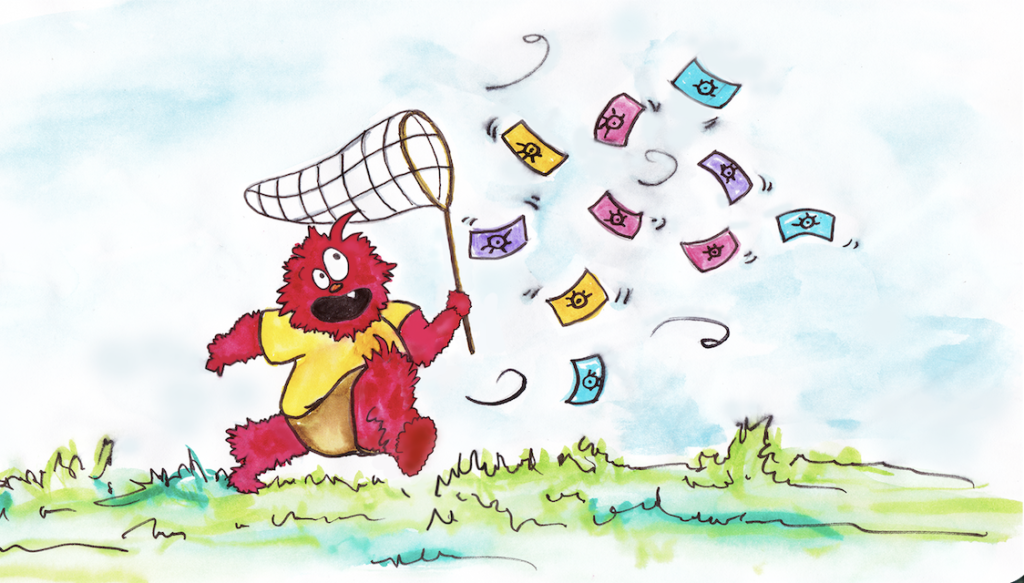
I want to change that with a classroom set of Blart Boogerswatch Vs. His Wallet—a hand-illustrated picture book that sneaks real financial literacy into a funny little monster story kids genuinely ask to re-read.
Blart feels RICH. He got fifty monsterbucks for his birthday and he’s just ten away from a ticket to MONSTERLAND, the greatest, stinkiest place on the planet. All he has to do is stop spending. Except he can’t. Through Blart’s spending struggle, students learn delayed gratification and opportunity cost—concepts that stick far better than worksheets ever do.
The book aligns to Jump$tart National Standards, Common Core Math and ELA, CEE, and FDIC Money Smart themes. Every purchase includes free lesson plans and discussion guides, so there’s no extra prep work—it’s ready to teach. I’m asking for [NUMBER] copies at $19.99 each to put this in every student’s hands during a read-aloud.
Research shows money habits form by age seven. My [GRADE] students are at exactly the right moment. With your help, this is a read-aloud that teaches.
Request: $[AMOUNT] for [NUMBER] copies of Blart Boogerswatch Vs. His Wallet ($19.99/copy), a standards-aligned financial literacy picture book for grades 1–5. Unlike worksheet programs, through Blart’s spending struggle, students learn delayed gratification and opportunity cost—through a story they actually want to finish. Free teacher materials (lesson plans, discussion guides) are included, so the entire request funds books in our children’s hands. Money habits form by age seven; this investment puts that lesson at the age it counts. Vendor accepts purchase orders: stephanie@blartboogerswatch.com.
Dear [Name],
I’m writing to invite [Institution] to sponsor classroom sets of Blart Boogerswatch Vs. His Wallet, a financial literacy picture book for grades K–4, for students at [School].
The book teaches delayed gratification and opportunity cost through a single narrative. Blart feels RICH. He got fifty monsterbucks for his birthday and he’s just ten away from a ticket to MONSTERLAND, the greatest, stinkiest place on the planet. All he has to do is stop spending. Except he can’t. Through Blart’s spending struggle, students identify and comprehend these complex financial concepts—concepts that land when narrative does the teaching. The book aligns to Jump$tart National Standards, Common Core, CEE, and FDIC Money Smart for Young People.
A 25-copy classroom set is $499.75; each set serves 25 students annually and has a 5+ year shelf life.
For [Institution], this is a documented, standards-aligned financial education contribution to local elementary students—the kind of community investment that fits squarely within CRA community development activity. A supporting memo for your compliance file is available at [moneymonsterskids.com/cra-memo]. Sponsor recognition can be included in take-home materials to families.
I’d welcome a brief 10-minute call at your convenience to discuss. Thank you for considering an investment in [School]’s youngest consumers—they’ll be your customers and account holders, and financial habits formed now stick for life.
Sincerely,
[Name, Title, School, Contact]
MEMORANDUM — For CRA File
RE: Financial Education Contribution — Elementary Financial Literacy Books
[Institution] provided [NUMBER] copies of Blart Boogerswatch Vs. His Wallet (ISBN 979-8-9946428-0-1; $19.99/copy; total $[AMOUNT]) to [School/Organization], serving students in grades 1–5 at [location/assessment area].
Nature of activity: The donated title is a financial literacy instructional resource aligned to the Jump$tart National Standards for Personal Financial Education, Common Core State Standards (Math, ELA), Council for Economic Education standards, and FDIC Money Smart for Young People themes. Content addresses budgeting, saving, delayed gratification, and opportunity cost. Publisher-provided lesson plans and assessments accompany the donation at no cost. The donated materials provide educational benefit across multiple school years, extending the community development impact of this contribution.
Community development rationale: The contribution supports financial education for students at [School Name], a Title I–eligible school serving low- and moderate-income families in [Assessment Area], within the institution’s assessment area, consistent with community development activity in the form of financial literacy education. [Cite institution’s CRA program policy section X.X, Financial Literacy Education — Community Development Activity.]
Documentation attached: Invoice/receipt, school acknowledgment letter, standards alignment summary.
Prepared by: [Name, Title, Date]
Project based learning activities using Blart’s coveted monsterbucks!